




A patent of addition protects an improvement or modification to an invention you have already patented, or applied for, in India. It carries no separate renewal fee and costs half the normal government filing fee, but it expires when your main patent does. It suits incremental upgrades to an existing patent, not standalone inventions.
This guide covers the position in India under the Patents Act 1970. A patent of addition sits in Chapter IX of that Act (Sections 54 to 56), and it is one of the standard patent application types the Indian Patent Office recognises on Form 1.
Quick Answer
- Same applicant: a patent of addition must be in the same name as the main patent.
- Timing: file on or after the main application’s date; it is granted only after the main patent is granted.
- Cost: no renewal fee, plus a 50% reduction on the filing fee (verified June 2026).
- Lifespan: it expires with the main patent, so its protected life is shorter than a full 20 years.
- Escape hatch: if the main patent is revoked, you can ask to convert it into an independent patent.
What a Patent of Addition Protects
A patent of addition is a patent for an improvement in, or modification of, an invention already described in the complete specification of a patent you hold or have applied for (Section 54). The earlier invention is called the “main invention,” and the upgrade rides on it rather than standing on its own.
Two conditions follow from that link. First, the patent of addition must be in the same name as the main patent or application. If the main patent is held by a company, the addition cannot be filed by an individual inventor, and the reverse is equally true; the Bombay High Court confirmed this in Ravi Kamal Bali v. Kala Tech (2008), reading the provisions as tying both patents to the same patentee. If ownership of the improvement currently sits with someone else, assign it to the same applicant before filing. Second, the improvement has to be a genuine improvement or modification of the main invention, not a fresh idea that merely sits in the same field.
This is why the route exists. Your earlier specification has already disclosed the core invention, so a later refinement can look obvious against your own filing, and an ordinary application would then face an inventive-step objection. A patent of addition removes that specific objection. The improvement must still be new in its own right, which is where the protection stops.
There is also a second way in. If you already hold two separate patents, a main one and an independent one for the improvement, you can ask to convert the improvement patent into a patent of addition, provided both are in the same name (Section 54). It keeps its original date.
When a Patent of Addition Makes Sense
The decision is a choice between two filings. When you hold a granted patent, or a pending application, and you have developed a refinement, you can file an ordinary patent application for the improvement or a patent of addition. A patent of addition suits an improvement that is incremental, tightly tied to the main invention, and would struggle to clear the inventive-step bar (the legal requirement that an invention be non-obvious) against your own earlier disclosure.
A simple example: you hold a patent on a container seal, and you later add a small locking feature that makes it harder to tamper with. On its own, the locking feature might look obvious next to your original seal, so an ordinary application could draw an inventive-step objection. As a patent of addition, the improvement is protected from that specific objection, the one based on your own main invention. It still has to be new and otherwise patentable. The signal: if the upgrade is worth protecting but looks obvious over your own main invention, the patent of addition is usually the right route.
When a Patent of Addition Is the Wrong Route
A patent of addition is not always the better option. Reach instead for an ordinary patent application, or rethink the filing, when:
- the improvement is strong enough to stand alone as its own invention;
- you want a fresh twenty-year term that does not expire with the earlier patent;
- the improvement is owned by a different person or company from the main patent;
- the improvement is already fully disclosed in the main specification, so it is not new;
- the main patent is weak, lapsed, abandoned, or no longer commercially important.
If any of these describes your situation, the cost saving of a patent of addition is usually not worth the shorter term or its dependence on the main patent.
Patent of Addition Fees: No Renewal Fee, Half the Filing Fee
Two separate savings make a patent of addition cheaper than a standalone patent.
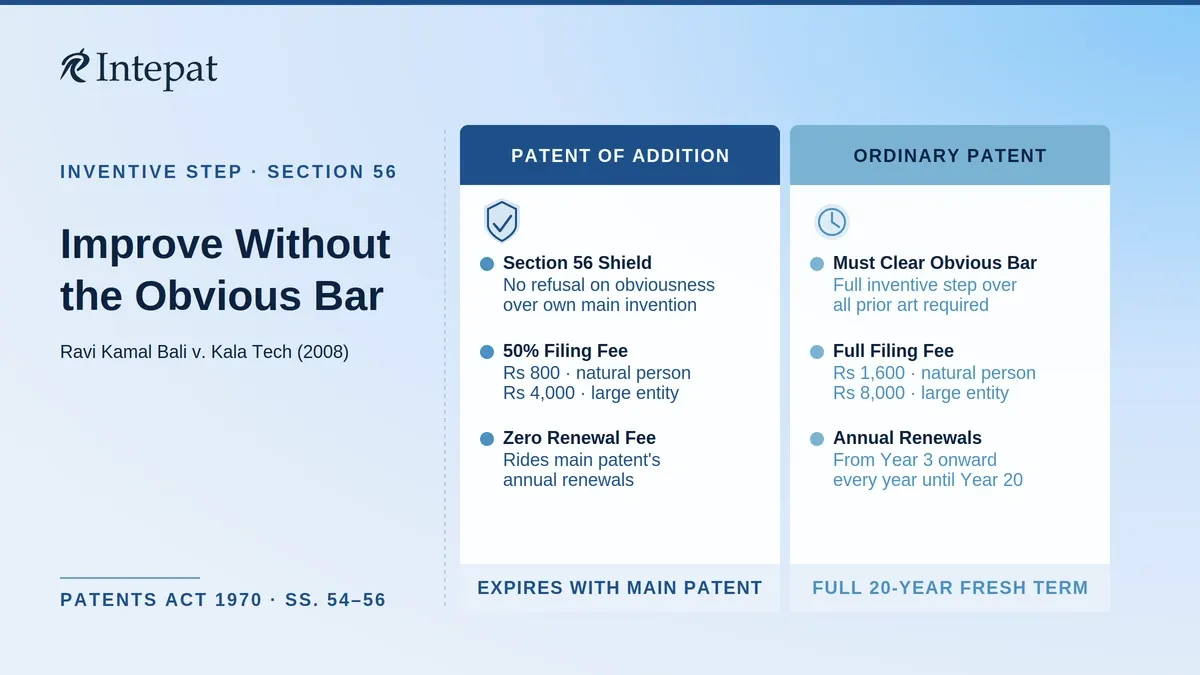
No renewal fee. A normal patent needs annual renewal fees from the third year to stay in force. A patent of addition carries none while it remains attached to the main patent (Section 55); it simply rides on the main patent’s renewals.
Half the filing fee. The official fee schedule gives a Section 54 application a 50% reduction compared with an ordinary application, and the specification fee gets the same reduction. The figures below are for electronic filing and are verified as of June 2026.
| Applicant | Ordinary Application | Patent of Addition (50% off) |
| Natural person / startup / small entity / educational institution | Rs 1,600 | Rs 800 |
| Other (for example, a large company) | Rs 8,000 | Rs 4,000 |
Physical (hard-copy) filing adds about 10% to these figures, and the same 50% reduction still applies. Renewal cost, again, is nil while the patent stays a patent of addition.
One caution: the 50% reduction applies to the application and specification fees, not to every later step. Other statutory fees, such as the request for examination, follow the normal schedule, so budget those at the full rate (verified June 2026).
| Talk to a Patent Specialist |
| Not sure whether your improvement should be a patent of addition or a standalone patent? Our patent team can tell you which route protects it for less. |
| Book Consultation |
How Long a Patent of Addition Lasts
Lifespan is the main trade-off you accept in exchange for the lower cost. A patent of addition is granted for the same term as the main patent, or for however much of that term is left, and it expires when the main patent expires (Section 55).
Because the main patent runs for twenty years from its own filing date (Section 53), and a patent of addition is usually filed later (the law allows it on the same date as the main application, but in practice it follows as a later improvement), its real protected life is normally shorter than a full twenty years. File the addition in year eight of a main patent and you get roughly twelve years of protection, not twenty. That is the bargain: a shorter term in return for lower cost and the inventive-step protection below.
The Inventive-Step Protection, and Where It Stops
This is the headline benefit, and it is narrower than it first sounds. A patent of addition cannot be refused, revoked, or invalidated only because it lacks an inventive step over the main invention, or over another patent of addition to the same main patent (Section 56). The Bombay High Court applied exactly this in Ravi Kamal Bali v. Kala Tech (2008), rejecting the argument that a patent of addition is valid only if it is inventive over the main application.
Two limits decide how far the protection actually reaches:
- The shield is specific. It removes only the inventive-step objection that comes from your own main invention. Prior art from anyone else, anything published or used by third parties before your addition’s filing date, can still be cited against it.
- Novelty still applies. The improvement must still be new, and in testing that, the examiner also reads your main specification (Section 56). So the addition has to add something genuinely not disclosed in the main patent.
In short, a patent of addition forgives the inventive gap over your own earlier work, but it is not a free pass against everyone else’s prior art.
Patent of Addition Versus a Divisional Application
These two are often confused because both are filed off an earlier application. They solve opposite problems.
A divisional application (Section 16) splits one application that claims more than one invention into separate applications. It carries the same invention forward and keeps the parent’s filing date. A patent of addition adds a new improvement that was not in the main invention, and it takes its own, later filing date.
| Patent of Addition | Divisional Application | |
| Purpose | Protect an improvement on the main invention | Split out a separate invention already disclosed |
| Provision | Sections 54 to 56 | Section 16 |
| Filing date | Its own, later date | The parent’s date |
| Inventive step over main | Not required | Must be a distinct invention |
| Renewal fee | None while attached to the main patent | Payable like any patent |
| Term | Expires with the main patent | Full twenty years from the parent’s date |
For a fuller side-by-side, see our guide comparing a patent of addition with a divisional application.
What Happens If Your Main Patent Is Revoked
A patent of addition does not automatically die if the main patent is revoked. In that case, the patentee can ask the court or the Controller, in the prescribed manner, to convert the patent of addition into an independent patent for the remainder of the term (Section 55). From that point it stands on its own, and the normal renewal fees become payable, on the same dates as if it had been an independent patent from the start.
A patent of addition is cheaper and shorter, but it is not fragile: a successful challenge that revokes the main patent does not necessarily wipe out the protection you hold on the improvement.
Deciding Whether a Patent of Addition Fits Your Invention
By now the trade-offs should be clear: a patent of addition suits an incremental improvement, closely linked to a patent you already hold, that you want to protect cheaply, while a strong standalone invention is better served by an ordinary application with its own full term.
Either way, two filing points are fixed. The patent of addition must be in the same name as the main patent, and it will only be granted after the main patent is granted. The application itself goes in much like any patent application, on Form 1 with a specification on Form 2, and that specification must name the main patent and state plainly that the invention is an improvement in, or modification of, it (Rule 13(3) of the Patents Rules 2003).
There is no rule that forces the choice. The patent of addition is an option, and for a genuinely strong improvement, a standalone patent with its own full term is often worth the higher cost. You can read the exact wording of the governing provisions in Chapter IX of the Patents Act 1970.
Frequently Asked Questions
A patent of addition is a patent for an improvement or modification of an invention already covered by a patent you hold or have applied for, granted under Section 54 of the Patents Act 1970. It protects incremental upgrades without needing a separate inventive step over the main invention, and it carries no renewal fee.
No. A patent of addition cannot be refused or revoked only because it lacks an inventive step over the main invention, under Section 56 of the Patents Act 1970. It must still be novel, and prior art from third parties can still be cited against it. The protection covers only your own earlier work.
A patent of addition lasts only as long as the main patent and expires with it, under Section 55 of the Patents Act 1970. Because the main patent runs twenty years from its filing date and the addition is usually filed later, the addition’s real protected life is normally shorter than twenty years.
No renewal fees are payable on a patent of addition while it remains attached to the main patent, under Section 55 of the Patents Act 1970. If the main patent is revoked and the addition is converted into an independent patent, normal renewal fees then become payable on the usual dates.
Yes. If the main patent is revoked, the patentee can ask the court or the Controller to convert the patent of addition into an independent patent for the remaining term, under Section 55 of the Patents Act 1970. Renewal fees then apply as they would for any standalone patent.
No. A divisional application under Section 16 splits out a separate invention already disclosed and keeps the parent’s filing date. A patent of addition under Section 54 adds a new improvement and takes its own later date. They solve different problems and are not interchangeable.
This article explains the law on patents of addition in India as at June 2026 and is for general information only. It is not legal advice. Government fees, forms, and procedures change over time; confirm current figures with the Indian Patent Office before you file. For advice on your specific invention, consult a registered patent agent.